Aesthetic–usability Effect
Good-looking designs often feel easier to use — even when they’re not. When something looks attractive, people instinctively assume it functions better.
Learn MindfulUX principles in depth with practical examples and exercises.
Connect with designers and share experiments, feedback, and resources.
Join now →Good-looking designs often feel easier to use — even when they’re not. When something looks attractive, people instinctively assume it functions better.
People often make decisions based on how they feel rather than what they know. This mental shortcut relies on emotional impressions to guide judgment quickly — especially when time or effort is limited.
The Aha! Moment is the instant when users first recognize a product’s real value. It’s the breakthrough moment when everything clicks — users understand why it matters and how it improves their life.
The environment — both physical and digital — silently shapes how people think, feel, and behave. Colors, sounds, lighting, and even temperature influence perception and decisions without users realizing it.
Good-looking designs often feel easier to use — even when they’re not. When something looks attractive, people instinctively assume it functions better.
People often make decisions based on how they feel rather than what they know. This mental shortcut relies on emotional impressions to guide judgment quickly — especially when time or effort is limited.
The Aha! Moment is the instant when users first recognize a product’s real value. It’s the breakthrough moment when everything clicks — users understand why it matters and how it improves their life.
The environment — both physical and digital — silently shapes how people think, feel, and behave. Colors, sounds, lighting, and even temperature influence perception and decisions without users realizing it.
Anthropomorphism is the tendency to assign human traits, emotions, or intentions to non-human entities. In UX, this means giving digital products a human touch — a friendly tone, expressive character, or emotional cue — that helps users feel connected.
The Attentional Blink describes a brief moment when the brain fails to register a second piece of information presented too soon after the first.
Authority Bias is the tendency to place higher trust and value on opinions or actions from perceived authority figures — experts, leaders, or professionals — even without fully understanding or verifying their advice.
Autonomy Bias describes the human preference for control and self-direction. People feel happier, more engaged, and more motivated when they believe they’ve made their own choices — even if those choices aren’t objectively better.
The Availability Heuristic is a mental shortcut where people make decisions based on information that comes to mind most easily — rather than the most accurate or complete data.
The Backfire Effect occurs when people are presented with information that contradicts their beliefs — and instead of reconsidering, they strengthen their original position.
The Bandwagon Effect describes how people adopt behaviors, beliefs, or products simply because others are doing the same. It’s the tendency to follow the crowd, often without evaluating whether the choice aligns with personal needs or preferences.
The Barnum Effect describes how people often believe vague, general statements are uniquely tailored to them — even when those statements could apply to almost anyone.
The Ben Franklin Effect describes how people tend to like someone more after doing them a favor. When we help others, our brain subconsciously assumes we must like them — otherwise, why would we have helped?
The Benign Masochism effect describes why people enjoy experiences that feel unpleasant — as long as they know they’re safe. It’s the thrill of controlled discomfort. For example, eating extra-spicy food, riding a roller coaster, or playing a rage-inducing game.
People spend more when using digital payments. When money feels less tangible, it becomes easier to part with. For example, you might splurge on dinner when paying by card — but hesitate if you had to hand over cash.
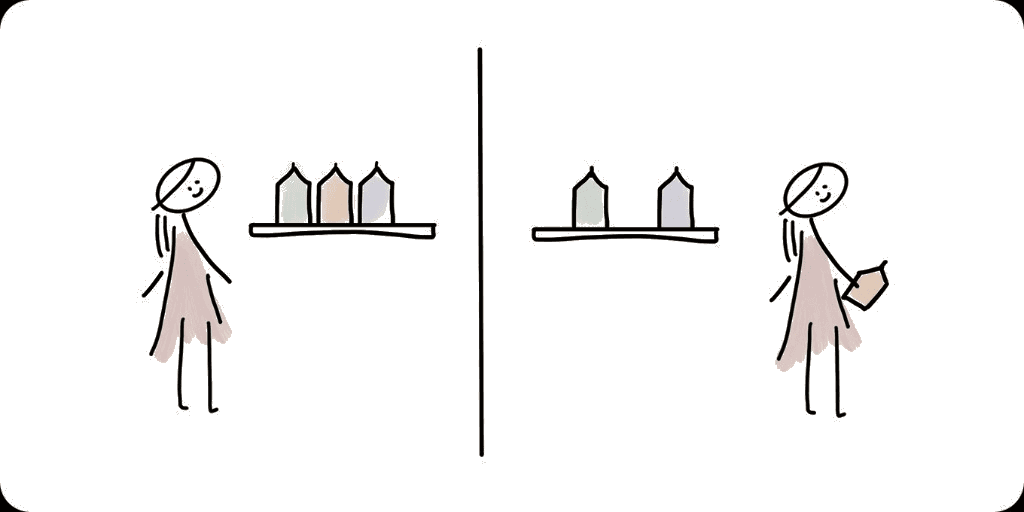
People tend to choose the middle option when presented with a group of choices. The central position feels more balanced, important, and trustworthy — even when all options are equal.
People perceive time subjectively. Our sense of how long something takes depends not only on the clock but also on what we’re doing and how we feel. For example, standing in a queue can feel endless, while scrolling on your phone makes half an hour vanish before you even notice.
Breaking information into small pieces. Chunking means dividing information into smaller, manageable bits so people can process, scan, and remember it more easily. For example, you’re more likely to remember a phone number written as 123-456-7890 rather than 1234567890.
The tension of holding two conflicting opinions or beliefs at once. Cognitive dissonance is the mental discomfort that arises when thoughts, beliefs, or actions don’t align. For example, you really want to buy a cool gadget online.
When your mind wanders away from what you were supposed to be doing. Cognitive drift happens when you lose focus and get carried away by unrelated thoughts or distractions.
The amount of brainpower used to complete a task. Cognitive load is the strain on your working memory at a given moment. For example, think back to school when you tried solving a tough math problem right after learning a new concept.
Clear, specific words are easier to understand and remember. People grasp and recall concrete information better than vague or abstract terms.
Paying more attention to information that supports your beliefs. People often notice and accept information that agrees with what they already believe—while ignoring or dismissing things that don’t.
Overlooking similar, familiar, or repeated content. Content blindness happens when our minds go on “autopilot” and tune out things that look too familiar. For example, while browsing Amazon, you may have noticed every sidebar ad the first time.
The desire to fully understand before making a decision. Sometimes, people don’t just want a quick answer. Instead, they prefer more information, details, or examples before acting.
Switching attention between different tasks. Humans naturally jump between activities or topics, but this often breaks focus.
People judge things by comparison. The way something looks, feels, or seems depends on what it’s compared to. For example, a $100 product can feel cheap when placed next to a $300 product—even though the $100 price hasn’t changed.
Imagining different outcomes from past events. People often think about what could have happened instead of what actually did. For example, after a frustrating checkout in an app, you might think: “If only the payment screen had a progress bar, I wouldn’t have backed out.
People prefer things that reflect their culture. When products, ads, or designs match people’s culture, language, and values, they feel more relatable. For example, global brands often run ads that use local slang or celebrate national holidays.
The itch to find out what’s missing. The curiosity gap is the feeling of wanting to know the missing piece of a story—the space between what we know and what we want to discover.
Create a free account to read every UX psychology principle.
Sign in to unlock all principles